Saturday, February 28, 2015

What Is a Missionary, Anyway?

"The moment you are converted to Jesus, you are sent out into mission. You’re either a missionary or a mission field. There is no third option."

I've really been mulling this quote from J.D. Greer over ever since I saw it on a friend's Facebook post. I sincerely believe it to be true, though it's a hard one for Christians to reconcile in our own thinking and to live out in our daily lives.  I suppose it's easier to think in softer terms, like  "being a light," or "being the salt." But, the fact is, while those things are true, their very softness implies a neutrality of sorts, as if simply living our Christian lives without any intentionality toward missions is enough.

Somehow I think we forget that Jesus said, "GO into all the world and PREACH the gospel... (Mark 16:15)." Notice - He didn't say, "Just BE."

Yes, we are called to BE Christians and Christ-like. Yes, we are called to BE believers, and faithful, and sanctified, and righteous, and light, and salt, and, and, and... But, 'be' is a verb that shows a state of existence. It's not an action verb, like GO and PREACH.  I propose that BEING all of those things is very, very imporant, but they're important for us. They're important for our relationship with Jesus. They're important for our eternities. Unfortunately, they're not necessarily going to help anyone else, though.

Don't get me wrong, I'm not saying that our faithful lives and fervent love for Jesus aren't important examples that can draw people to us, set us apart, and showcase us as different. In fact, they should be. They must be! If our lives aren't different enough from everyone else's that it's obvious that our citizenship is somewhere other than here on planet Earth, we seriously need to consider how we're walking out our faith. But just BEING different isn't enough. What are we going to DO about it?

What happens when people notice the light and love that is within us because of Jesus? What happens when someone asks you why you don't swear, or drink, or wear immodest clothes, or go clubbing, or do drugs, or sleep around, or a myriad of other choices we make because of our commitment to Christ?

What happens then?

Are we bold enough to "go there?" Are we bold enough to enter into the conversation, not with pointed judgement, but with genuine, gentle, loving conviction? Are we willing to GO, like Jesus said?

Are we ready, at any moment, to tell ohers about our faith, and who we have faith in, and why we know it's the only way? Are we equipped and willing to share the gospel message that changed our lives and eternities so that others' lives and eternities can be changed as well? We we willing to PREACH, like Jesus said?

I get it... not everyone is called to be a pastor of a church. Not everyone is called to move overseas in order to spread the gospel. But, everyone is called to be a missionary, and your mission field is right where you are.  It's at your job. It's at your school. It's in your neighbhorhood. It's in your church. It's in your family.

Look - Jesus died on the cross for YOU, dear friend, because He loves YOU. But, He also died on the cross for everyone else, because He loves them too. It is God's desire that not a single person should perish and live in an eternity separated from Him (2 Peter 3:9).  Getting to Heaven is easy, through Jesus. Whoever will call on the  name of the Lord will be saved.

But how can anyone call on the name of someone they don't believe in? 


And how can they believe in someone they've not heard of? 


And how can they hear without someone PREACHING it to them?
Romans 10:14

That's us, friends. You and me. That's who we are. That's what it means to be missionaries. So, I sincerely hope you are living a life in Christ that draws people to you. But, more than that, I sincerely hope you're telling every single person that God brings your way about Christ, and the reason your life and eternity are different because of Him.  

From one missionary to another - keep on keepin' on for Jesus. 


Saturday, February 21, 2015

Why I Want to do Stuff


The other day I wrote this on Facebook:

I woke up this morning with a very powerful conviction: I am not doing enough for Jesus.  He has given me everything and I still give him very little of my life.

John 3:30 NKJV
He must increase, I must decrease.


There were a few comments on it, and I had some discussion about it with my wife.  So, I would like to tell the back story.

Let me start off by saying that Facebook is, to me, a medium that should only be used for short posts.  Though I sometimes read longer posts, I don't usually, so I try to keep mine short, concise, and to the point.

Anyway - I am a server.  I like to serve a lot.  In fact, I think it was an issue in my last job. I was a manger there, and even though I think I did an alright job, I had a habit of serving my employees  instead of leading them.  Of course, to be an effective manager I think there is a part of you that needs to serve (Christ being a good example for this), but too much can leave people not sure what to do or where they stand in their job.

So, I think I have always been pretty good at serving the Lord and giving myself to serve in whatever way possible.  The problem with having a servant's heart, though, is sometimes it feels a little empty.  When you're tired or frustrated, it gets hard to serve.

I have been reading a lot about God's love lately.  Many of the books I read are about people who have fully given their lives to Christ because they have felt his love wash over them.  This, to me, was the missing key.   I want to serve more and be more bold, and the way to do that is to see his face and feel his love.

Because of this, I have been praying.  For months I've prayed, "I want to feel your love Lord.  I want to see you more as a Father, not a boss."  To be fair, I have felt God's love before, but I wanted more.  I wanted that love that makes you not worry about tomorrow.

So, on February 2, 2015, I woke up to His love.  I felt warm all over. There did not seem to be a negative thought that could come in.  But, it was not an outward experience. It was like my very soul was wrapped in his love.

That night, after feeling this peace all day, the expression that came out of it was what I posted on  Facebook.  The whole story sounds a little different than the simple expression I posted, but how do you post all that in a short statement?

I do not believe my works will get me into heaven. I do not worry about an angry God saying I am not doing enough.  I am going to heaven, and my Father delights in me.

What I do believe, though, is that when you feel the love of God, your only response will be, "How can I serve you more?"

Sunday, February 1, 2015

Doing My Patriotic Duty

Happy Superbowl Sunday! While most people were trying to decide whether to root for or against the Patriots, I was busy doing my own, um, patriotic (?) duty.

That's right... I signed our family up for insurance through the Healthcare.gov exchange.

Ugh.

It pains me to say that, to be honest.  I don't even want to get into the ins and outs of how I feel about the Affordable Care Act, or how it was passed, or what implications it has for our nation. In a nutshell, I will say that I am NOT a big fan. (That's an understatement of grand proportions, by the way, in case that didn't come through loud and clear.)

What I do want to talk about is *why* I spent my Superbowl Sunday signing us up for insurance in a country we don't even live in through an exchange I never thought should have existed because of a law I disagree with.

We've done a lot of praying about this whole situation. We've researched the law, gotten advice from others, checked with everyone from our tax advisor to our U.S. Senator. And, what it all boiled down to in the end for us is that we have a choice of which citizenship is most important to us - our U.S. citizenship, or our Kingdom citizenship (Phil. 3:20).

I bet you can guess which one won out.

First off, let me be clear that we are absolutely, unequivocally going to need to either buy insurance or pay the fine for not doing so. Yes, I am aware that we live outside the U.S. so no one *thinks* it should apply to us. Yes, I know that a lot of people *think* the law says X, Y, or Z, so they *think* it doesn't affect us. Yes, I know that there actually are exemptions available, even exemptions for people living in a foreign nation. But - trust me on this - I've explored this law inside, outside, and upside down, and there really is no way to get around it for us. At least, not while maintaining our integrity and following what we know to be right.

As a U.S. citizen I know that there are probably ways around buying mandatory insurance that, while technically not meeting the letter of the law, would certainly be acceptable enough and in keeping with what most believe is the spirit of the law, at least. (That is to say, most people wouldn't give them a second thought, and we'd probably never get in any trouble for doing them.)

These are things like just checking "yes" on our taxes when asked if we have insurance through our employer. I mean, technically we do. Kinda. Except that my employer isn't really an employer since I'm just a volunteer.  Oh, and our insurance doesn't meet the minimum coverage requirements set forth in the Affordable Care Act law. Oh, yeah... and our insurance is in GUATEMALA.

So... yes, we have insurance. But, no, it doesn't count. And, even though we could have saved a whole lot of hassle by just checking, "yes" (and hoping we never got audited), it wouldn't have been honest or legal. Maybe as a U.S. citizen I'd have been tempted to do the easy thing, but Kingdom citizens do the right thing. For me, this is about a whole lot more than fines or laws or getting caught. James 4:17 says that if I know the right thing, and do something different, it is a sin. A sin, y'all.

I'm not willing to sin over the ACA law.
But why would not buying insurance be a sin?
Romans 13. That's why.

As much as I might not like it, or completely understand it, or feel happy about it, God (through Paul's letters to the Romans) tells me that I must be subject to the rulers above me, because all authority has been established by God.

<giant sigh>

Well... there you go. If God has established the authority of the president and congress of the United States, and they have implemented this law, then I am going to follow it. Let me be clear here - I'm not saying that there are never circumstances under which people should disobey the law or work to overthrow the authorities above them. For example, if a law requires me to act in a way that is against my Christian principles or Biblical requirements, I will break that law. My Kingdom citizenship will always outrank my U.S. citizenship. But, when the two are not in conflict, no matter how irksome it may be to me, the former requires me to obey the latter.

This is where the rubber hits the road. This is where I've got to decide if I *really* believe that the Bible is my guidebook in all areas of life. This is where I decide if I'm going to live out my faith every day of the week, or just on Sundays and when it's convenient. This is where I get to live out Romans 13 in more than just a theoretical way, even if it hurts.

So, regardless of whether the Seahawks or the Patriots win, I know I've done my patriotic duty - not just as a U.S. citizen, but as a citizen of the Kingdom of the Most High God.  Now that's an authority I'm proud to serve for eternity, which makes even signing up for insurance in a country we don't even live in through an exchange I never thought should have existed because of a law I really disagree with all worthwhile.

Thursday, January 15, 2015

Endurance


So do not throw away this confident trust in the Lord. Remember the great reward it brings you!  Patient endurance is what you need now, so that you will continue to do God's will. Then you will receive all that he has promised.   - Hebrews 10:35-36 NLT

I have a bad habit. It may even lead to a little sleep deprivation at times.  Before I go to bed I like to read.  Most of the time I read something I already own. Sometimes something will come into my mind, and I will look it up on the internet, and suddenly it's four in the morning!

So, the other night the thought came to me, "You like testimonies don't you?"  I responded back, "Why, yes I do."  The thought continued, "What about the testimonies of atheists who were once Christians?"

I'd never read those. I'd never even thought of reading those.

A quick internet search of 'Christians turned atheists' led to a treasure trove of stories.  Some interesting, some boring, some very sad.

Most of the stories, but not all, started, "I believed... was part of the church... example, example, example....  Then _______ happened." Typically ________ was some kind of tragedy. The death of a close family member seemed to be the most common, or a bad illness or something someone prayed for that didn't happen.  They usually continued by saying, "I lost faith, and then I started reading different atheist authors and websites.  I found comfort in those things and am now free of believing in a myth / fairytale / superstitions / religion."

It was amazing to me how the stories were so similar, including many from ex-pastors turned atheists. They seem to be kind of rock stars in the atheist world, often turning to full time speaking about how they were 'delivered from religion,' and making good money doing it.

All these stories got me thinking about my own story.

I gave my life to God at eleven, and was saved at thirteen.  I served in my church, often going to services every-night during busy times.  Then, tragedy happened. My mom got cancer. After three years. and an especially horrible last six months, she was gone.  I lost faith.   

Sounds familiar, right? But, now for the difference.

I was not going to let God off the hook.  That is what switching to atheism is, in my view.  "God these bad things happened, so I am not going to believe in you anymore. That will teach you!" 

Not good enough.  I wanted answers. Why did prayer not work? Why did this happen to mom, who was such a faithful person? So, I dived into the Word. I read the Bible.  I read literature from the church I was going to.  I watched YouTube videos of pastors. I read websites of different  ministries - both ones I knew, and new ones. I wasn't doing this passively. I was looking for answers.

Then, on September 3, 2010, the Lord answered me.  It was such a personal and private experience that I cannot really describe it, but it was life changing.

Even after the encounter I still had things I struggled with.  I went through severe depression, had a lot of fear, and took a long time healing.  Jesus brought me through each hard thing, though He definitely did not cause them.  Most of them were caused by my own anger, bitterness, and unforgiveness toward other people.  As the Lord led me through the challenges (sometime with me pulling back) I became more and more free.  Then He could start using me. And, He has, in ways that I couldn't even imagine four years ago.

Let's go back to the beginning, with me reading late at night. When people go through a challenging time, they must choose whether they're going to push deeper into knowing the Creator of the Universe, or believe a lie that brings temporary comfort, but not eternal comfort.  A lie that makes life about us, instead of about Him.  A lie that will be of no help the next time a challenge happens.

In the Hospice room with my mom and aunt, my mom gave me a present that I think about weekly.  In the middle of her pain, and close to death, came this song from her lips:

"Jesus loves me this I know, for the Bible tells me so..."

Sunday, January 4, 2015

Know Your Joe!

While all of our friends back home were shivering in the near-zero temperatures, our family spent some of the very first days of January, 2015, touring the Dalton Coffee Plantation just outside the town of Antigua, Guatemala.  It was SPECTACULAR (even though, to be honest, we did get a little hot in the blazing sunshine), and I learned a LOT about coffee.

It was so sunny that Mark needed sunglasses. Check out the reflection in their lenses!
So, if you're not too mad at me for rubbing in our excellent climate here, please read on to learn a whole lot more about that humble beverage so many of us take for granted. (Sorry, I know it's long. But, it's very interesting information!)

This was our awesome tour vehicle, which picked us up in Antigua and took us to the plantation.

Cutie pies on the left side of the truck.

Cutie pies on the right side of the truck.
First off, you should know that coffee originated in Africa. The reason that coffee plants contain caffeine is to act as a natural repellent. In essence, we are the only critters who actively seek out this bitter plant. Most others avoid it like the plague. There are actually only a couple of animals who can and will eat coffee (outside of some nasty insects, of course.)

The first is a type of civet cat whose digestive system allows it to partake of whole, ripe coffee beans. If you're a real coffee connoisseur (or just ridiculously rich, given how expensive it is) you might have tried a cup of this special, Indonesian coffee. The process is pricey, but somewhat inelegant. After the cat eats the bean, it goes through its entire digestive system, and is <ahem> collected at the end of the process. Only then is the bean cleaned (one would hope), roasted, and sold.  

The other type of animal which eats coffee beans is the goat, of course. Legend says that this wild plant was a favorite of goats in Ethiopia. One day the shepherds noted how hyper it made the animals, so they took the red beans home and made their own infusion with hot water. Though it tasted terrible, it did help keep them awake. Eventually they sold the beans to a monastery, because the monks needed focus and energy for their work of copying scripture. Eventually, through trade, it made its way to Arabia, which is why the best quality coffee today is called Arabica.

There are four types of coffee plants. The two most common, which make up 80% or more of what we drink, are Arabica and Robust. Robust coffee is the only kind which makes a tree, rather than a bush. It is (as its name implies)  much heartier, and a much more prolific producer, but it's also a much lower quality of fruit and has 50% more caffeine than Arabica. When you get cheaper coffee, you're most likely drinking Robust coffee beans. (Unless, of course, you're drinking instant coffee, which we found out was really not made of much coffee at all, and was mostly chemicals and fillers like chickpeas or chicory.)

Welcome to the Dalton Coffee Plantation!
Anyway - back to the Dalton Plantation. Guatemala is one of the main producers of coffee in the Western Hemisphere. Even though it is a very small nation, its mix of mountainous terrain, temperate weather, and lots of sunshine make it nearly ideal for growing coffee. It should be noted that, aside from flavorings which can be added during the roasting process, the natural flavor of coffees comes from the conditions in which it was grown. The same plant, grown in two different places, would produce two different flavors. There are approximately eight "coffee zones" in Guatemala, though Antigua is considered one of only a handful of 'balanced' locations in the world. The coffee from there really is pretty spectacular and sought after.

Anyway - growing conditions in Antigua (and the rest of Guatemala) are *nearly* perfect. Nearly, I say, because it has one major drawback - volcanic soil. While this type of fertile soil is good for growing almost everything else, it has a tendency to promote nematodes. Nematodes and coffee don't mix.

At least, nematodes and the best types of coffee don't mix, unless you're willing to get creative. So, in order to maintain both high yields and excellent quality, producers in Guatemala have used an innovative grafting technique which pairs the roots of Robust coffee plants (which are immune to nematodes) and the stems and leaves of Arabica coffee plants (which produce better quality coffee) for the perfect combination! The process isn't easy, since it involves making a V shaped slit in the root plant, and a corresponding cut in the top plant, in order for the cores to fit snugly together. Then, a special tape is used to wrap the "new" plant. This process is done when the stems of both plants are about as a big around as the lead in a number 2 pencil!

If you look closely, you can see the graft on this little plant.
At the Dalton Plantation, they have a nursery where they start both types of plants, and do their grafting on-site. 100% of their plant grafters are women. It was discovered, after a process of trial and error, that when men grafted, they had a 50% survival rate. When women did the work, they had a 92% survival rate. Eventually they figured out that the difference was due in small part to the delicate hands and patience of the women workers, but mostly it was because of the difference in Ph between women's sweat and men's.

Every year the plantation has a contest to see who can successfully graft the most plants in 20 minutes. The winner, for the past 3 years straight, has been a woman who's worked on the grafting floor for over 35 years. In just 1/3 of an hour, using only her hands, a razor blade, and the wrapping tape, she grafted 84 plants, with a 94% survival rating. Wow!

Anyway - after the plants are grafted, they're left in the nursery for around a year, after which they're only about one foot tall. (Arabica coffee plants grow very slowly.) Then, they're moved to a production row, but won't being putting on the delicate, white flowers (called false jasmine) that turn into coffee beans until they're three years old. At four-years old, the plantation begins picking the ripe beans, though they're still not fully mature until they're five to seven years old, at which point they're approximately three feet tall.

Coffee plants typically survive here around 35-40 years, though they only produce for 25 or so of those years. After plants have reached around 12 years of age, their quality starts to decrease, so the plantation prunes them down to their original graft point, and then has to wait another four years for them to produce well again. In total, the plants are pruned three times during their lifetime.

This is the coffee nursery. The tiniest plants are newly-pruned. The taller ones around just under a year old. 
The annual cycle of the coffee plant is even more interesting than the lifetime cycle! Each year the plants start to flower in October. The fruits develop rapidly, and begin being ripe in November. (Incidentally, this is why the Guatemalan school year runs from January through November - so kids could be off to help with the harvest, just like the U.S. schedule!) The peak time for harvest is December and January, though it can last all the way until March.

Once the plant has flowered, it begins producing berries, which start off as green, then turn yellow, and are considered ripe when they are shiny and dark red, like a cherry. A mature (seven or so year old plant) will produce nine pounds of ripe beans, which will translate into only one pound of roasted, processed coffee! It takes 30-40 red berries to make each cup of coffee.

Because of the delicate nature of the plant and the fact that not all of its berries ripen at the same time, all of the coffee here is harvested by hand. The Dalton plantation has just under 400 acres in coffee plants, which must be grown in the gentle shade of other plants. The trees planted with the coffee  on this plantation are fast-growing and frequently pruned, yielding lumber as another cash crop.

This is our tour guide, Diego, holding up a ripe coffee bean. Behind him you can see an adult plant with red berries, ready to be harvested.
Each year the Dalton Coffee Plantation employs 200 to 300 pickers from the surrounding communities for its coffee harvest. It is stable, sought-after employment, and there are people who are 3rd generation pickers. In fact, coffee picking is a family affair. While the children are not officially hired, or expected to help with the harvest, families typically come together, including little ones on mothers' backs, toddlers in tow, and even the family dog!

Blue sky. Mountains. Coffee plants. Trees. Cut timber. Workers heading back from the harvest.
<sigh> There were some really little kiddos there.
It was conflicting to see children at a work site, but I had to keep in mind that this type of arrangement ensures jobs for the adults, safety for the kids (since they don't have to be left alone at home), and money to put food on the table. Plus, most likely, many of the little kids I saw along the road, walking to the coffee fields, are being taught by their parents how to harvest these delicate beans, which means they'll be more prepared to do well on the job when it's their turn to take over.

Each worker harvests 35-50 pounds of ripe coffee beans per day, and deposits their full bags on trucks like these, which are then taken to the on-site processing plant. 
While on the tour, we had the chance to pick our own ripe coffee bean. (It's a twist-and-pull process, just so you know.). Diego, our guide, explained to us that there are actually four layers around each coffee bean. The first is the red hull, which you can easily remove by just squeezing the bean. This layer actually has 40% of the bean's caffeine, and (when fresh) tastes and smells almost exactly like a red, bell pepper. The gift shop at the plantation actually sells coffee hull jelly, which we are excited to try!

The hull and whole bean.

Coffee cherry jelly!
The second layer is called the sugar, or mucilage, layer. It's kind of slimy. If you put a raw, hulled bean in your mouth it's quite sweet. Poor kids (especially those along for harvest) often chew on them as a kind of candy treat. We'll get to the other two layers in a moment.


While we removed the first and second layer by hand (or mouth) on the berry we picked, that's not the typical process! Usually the beans are sorted and taken for processing within an hour or so of being picked. The first process is a soaking, which causes the bad (light) berries (usually those that have been drilled into and eaten by bug larvae) to rise to the top. These are flushed into a waiting wagon, and will be used for very-low quality coffee or for compost.

Behind that back wall is the holding tank for the water and berries. The green tube going to the right takes the bad (light) berries outside.  The bigger, center tube takes the good berries to the wet mill and pulper, which removes the top layer of the picked bean. 

They had fancy machines, but most of them were old, since the process hasn't changed for decades!
After the first layer has been removed, the beans are transferred to holding tanks where they're submerged in water for 30 hours. This, apparently, is the exact amount of time necessary to allow some of the sugar layer to permeate the beans, giving them a hint of sweetness, and to have just a bit of fermentation begin. After 30 hours, the beans are drained, put into a centrifuge to remove any remaining mucilage layer, and then the drying process begins.

Here you can see the newly-drained beans after 30 hours of soaking. They're under burlap bags.
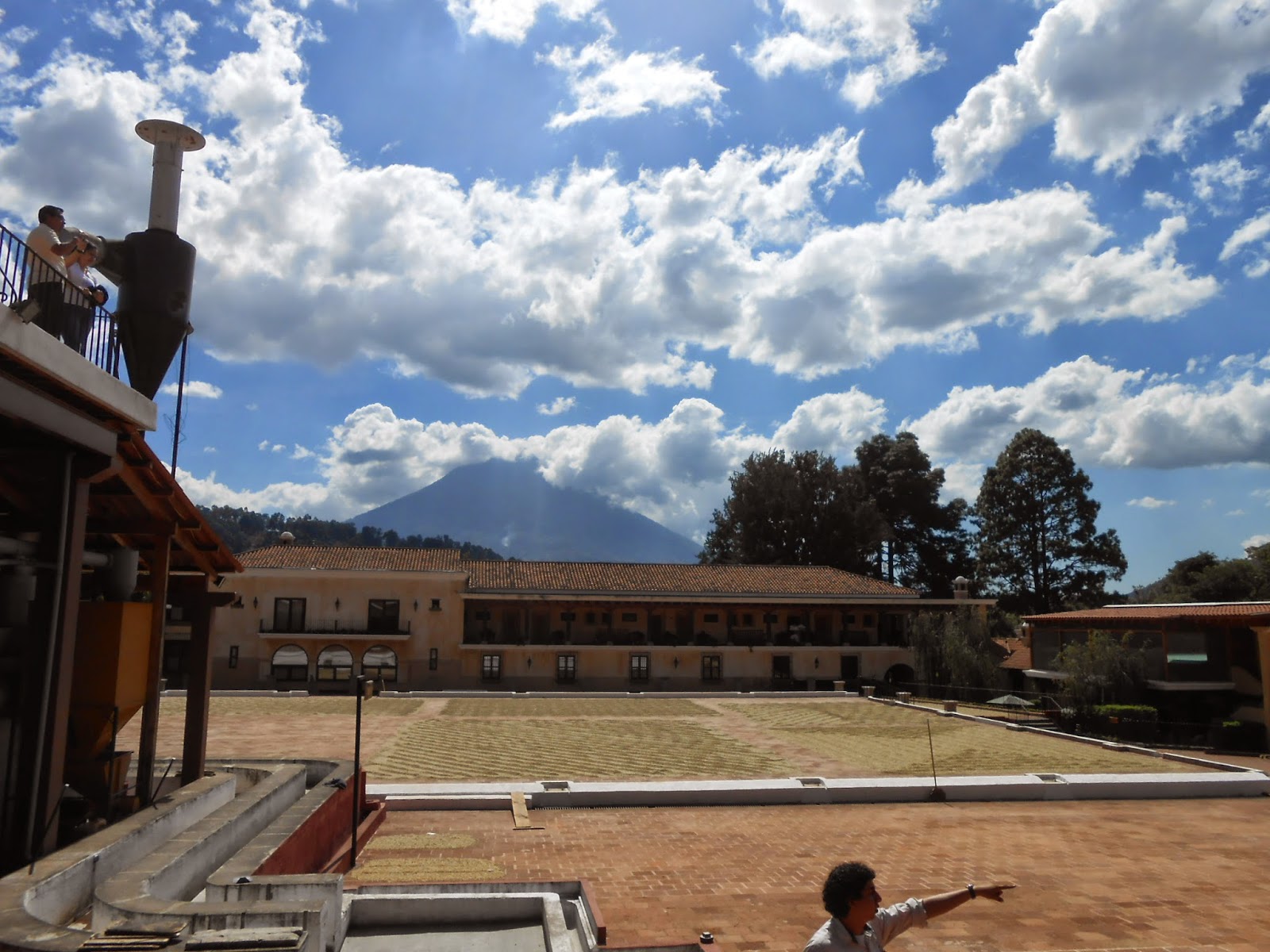
Drying here (like most other parts of the process) is both precise and scientific, and traditional and natural. Other (cheaper) coffees are dried mechanically. In this plantation, every bit of the coffee is dried in the Guatemalan sunshine, on huge drying patios made from terra cotta tile, which help absorb the extra water. Drying masters monitor the beans to get the moisture content down to 11-12%, which takes approximately 8 to 10 days. At night, they're covered to prevent dew falling on them. During the day, they're shuffled and moved every 45 minutes to ensure even drying.

The picturesque drying patios are a great place for a photo op. :) 

Our tour guide, Diego, standing next to the tool used to move the beans during the drying process.

Vast. Impressive. Beautiful.
Once the optimal dryness has been achieved, the beans still have two layers left. While they can be stored in this condition for up to eight months, they usually remove these layers almost immediately. The harder one is called the parchment layer, and is removed by friction in a dry mill. The last layer is called silver skin. Most also comes off in the dry mill, and the rest is burned off in the roasting process. In between, the coffee goes through a winnower which blows away powdered silverskin and any broken bits of beans.

A handful of newly-dried beans.

The parchment layer with the silverskin underneath.

Gold bean, bean with silverskin, bean with parchment.
 (Whew! It's been a lot of steps so far between ripe beans and cup of coffee. But wait, we're not done!) After the beans are dried and milled, they're sorted by size on an agitating table. The biggest beans are usually the most bitter. The smallest are the most acidic. For this reason, the medium-sized beans are the best. Often, people think that the best coffee only comes in whole-bean. However, blend master often combine just the right flavors of beans to create a sublime mix. Because these beans are different sizes, they are ground before packaging. So, if you're a 'whole bean only' person, you might want to reconsider!

These Oliver brand agitating tables sort the beans by size. 
After the beans have been dry milled, and sorted, they're called "gold beans." The plantation sells 75% of their coffee in this stage, because then buyers can choose to roast and flavor it however they want. Their biggest buyers are in Japan and South Korea.

The remaining 25% is roasted in-house.  The roaster can hold up to 200 pounds of gold beans at a time, and has three cylinders. The middle one is where aromatics can be added to change the flavor. The middle one holds the coffee, and spins constantly to avoid burning. The outer one is where the heat comes in, usually around 400 degrees Fahrenheit. The whole process takes approximately 25 minutes, and master roasters rely on their sense of hearing to know when the beans are roasted, since the separation of the two parts of the bean makes a crackling sound, not unlike the popping of popcorn.  After roasting is complete, the beans are put into a sieve-bottomed cylinder and stirred constantly for an hour or so until it cools to room temperature and is taken for grinding or packaging.

The actual roaster here is the green cylinder in the lower right hand corner. The round, silver thing is the cooling rack.
 Incidentally, the roasting process also affects the caffeine content. The longer you roast coffee, the less caffeine it has, since much of it evaporates in the heat. So, if you like a really strong cup of coffee, you sould choose light colored beans/grind, like an Italian roast. Medium roasts will have a medium amount of caffeine, such as French of City roasts. The darkest roast, Turkish roast, actually has the last amount of caffeine, though it does have a very strong flavor. We had the chance to try their city-roast. It was delicious!

Free hair nets!

Sarah actually really loves coffee!
Rebecca does not like coffee! Rachel does, though. Incidentally, we learned that you don't actually get any of the flavor of coffee in your first sip, only its intensity. It's not until the 2nd or 3rd sip that you actually taste the real flavor of the coffee!
After it has been tested by master tasters, graded (by number of stars), and blended (sometimes), coffee grown at the Dalton Coffee Plantation is sold through their online store.  Their finest-quality coffee is 5 star, 100% Arabica, Antigua-grown, and sun-dried, whole bean coffee. It's probably some of the best Java on the planet, and you can buy it and have it delivered directly to your door! I highly recommend them. :)

I got to try this amazing coffee after our tour,and can vouch for the fact that it's truly delicious!
Hope you enjoyed this plantation tour as much as we did, and learned a lot! Next time you're ready to take a sip of your first cup of the morning, you might stop to consider just how much goes into making a perfect cuppa joe!

Thursday, December 25, 2014

Christmas in Xela

In case you haven't picked up this information from our previous posts, or this is your first time visiting our blog, allow me to state the obvious - our new life here in Xela is very different from our old life in Iowa. Everything is different. Little things. Big things. Daily things. And, especially, holiday things.

This is our first Christmas in Guatemala, and we have really been struck by what a big change it's been! For example:

In Iowa we would sometimes have poinsettias on the table as a festive centerpiece. Here, poinsettia bushes grow in people's yards and can be up to 10 feet tall.

Yep - that's a poinsettia bush blooming behind my lovely daughters!

In Iowa it is usually very cold, and we would often have snow for Christmas. The kids could go outside and build a snowman. Here, we went to an outdoor Christmas party one evening. We did have a snowman, though. Granted, it was a pinata, but a snowman nonetheless. Apparently, in Xela, children destroy snowmen instead of building them.

(image found on pinterest)

In Iowa, almost every school-aged kid cuts out paper snowflakes at some point during December. At my school, I suggested to my students that they should make some for my room, but none of them had ever made them before! In fact, many of them had never seen actual snow before, either. We were all fascinated by the craft-inspired cultural exchange.
 
(image from crafthubs.com)

In Iowa, people enjoy going caroling (though usually inside, like in hospitals and retirement homes) to spread cheer and joy. Here, people have Posadas, where groups of friends gather and walk through the streets carrying lighted candles, blowing whistles and banging on drums, and knocking on doors to find room at the inn for Mary and Joseph. One similarity here, however, is that both caroling and posadas end with hot chocolate and cookies. Those things might be nearly universal!


In Iowa, one of our family's traditions for many, many years was to put together gift boxes for Samaritan's Purse's Operation Christmas Child. This year, we didn't. And, though we heard about local people doing distributions of these goody-filled shoe boxes from this GREAT organization, we had the opportunity to do something little more personal. Some friends of ours who help out at a shelter for abused women and children invited us to come along as they distributed gifts, gave out a delicious tamale supper, and shared a simple gospel message.  These activities had the same purpose, but different methods and locations.  I must admit, getting to hug teen moms, tease (and be teased by) kids, and hold babies was pretty awesome!


 In Iowa, we always had a two-to-four-hour drive (depending on where we lived and where we were going) to get to where we celebrated Christmas. In Xela, we will always have a two-to-four-hour drive (depending on road conditions, how many protests there are, and how often we get lost) to get to the Mexican border to get our passports stamped.

This is a section of the curvy, mountainous road on our trip.
In Iowa, we always loved it when Papa (my dad) made a roaring, crackling fire in the fireplace. In Xela we also have roaring and crackling, but here they're from fireworks. It's a tradition in Guatemala to set off fireworks at midnight on Christmas Eve.  (To be honest, they set off fireworks for a LOT of things!) I have literally never seen so many fireworks at once, and I'm a certified pyrotechnician in the States! It is a breathtaking spectacle to behold, and I'm excited to see the repeat performance on New Year's Eve. (I told you they really like fireworks.)


In Iowa, Christmas is a time to celebrate the birth of Jesus Christ. In Xela, it's... oh, yeah! It's the same thing! Though Christmas in the U.S. has too much focus on Santa and commercialization, and Christmas in Guatemala has too much focus on "Santa Maria" and religious traditions, the heart of this holiday is still about the fact that the creator of everything loved fallen, broken humanity enough to come and dwell with them on Earth.

(Image from pinterest)
No matter the language, the traditions, the climate, or the location - it's still the best story ever told, and cause for celebration! So, Merry Christmas from the Farriers of Faith in Xela, Guatemala. May you be truly blessed in the year to come!


Sunday, December 21, 2014

Recap

Sheesh! Feels like it's been forever since we've posted. Sorry 'bout that. Life got really busy, really fast the last few weeks. I guess we haven't had time for much self-reflection, let alone writing! So, here's a brief recap of what we've been up to:

  • Our semester is over at school. Wow. Half a year is under our belts. The girls have settled in to the school routine well, though it's still a big adjustment. Their grades on their final report cards were very good. But, even better, they are really feeling like they're starting to fit into the groove of things there. I, also, no longer feel like I'm scrambling to keep one day ahead, and have really gotten to know my students and their needs well. I was also able to sign my contract for next year. So, I'm officially going to continue to be the High School English teacher, and we'll officially be here for the 2015-2016 school year. 
  • The Bible college where Mark works follows a Guatemalan school calendar, so they have been on break since the end of October, and will start back again right after New Year's Day. Even though there haven't been students, there has been a lot of work to do. They've been working on tiling the floors of the classrooms, painting, doing some work on the roof, and keeping up on general maintenance needs. Once school starts again, Mark is planning on trying his hand at teaching a course or two. It's a very exciting step, and I can't wait to see if he'll get bitten by the teaching bug!
  • We had the privilege this past week of going with our friends to the women's shelter to help hand out gifts and provide a supper. There are about 35 people living there, more than half of whom are young children. It is hard to think about what they must have come from to end up there. We already help support the shelter financially each month, but are hoping to be able to do more in the future. It was hard to see so many people hurting, but good to know that they are safe (for now) and to get to be a part of bringing some Christmas joy.
  • Spanish lessons are going well. Mark has been doing two hours per day, five days per week. I do one hour lessons, twice a week. We've been working on squeezing in some time for Rachel, as well. Our Spanish tutor is a wonderful Christian man, and we are grateful for both his excellent skill and the ability to bless his family financially by paying for his services. Over Christmas break we're planning on doing around 30 hours of lessons, mostly for me and the three girls. It's not exactly the way we'd planned on spending our time off, but we desire to do so much more here, and language has been a limiting factor. So, more lessons it is!
  • One of the requirements of our travel status is that we leave the country every three months, whether we want to or not. So, I'm writing this blog from a hotel room in Tapachula, Mexico. In a way, we have a forced vacation (of sorts) every 90 days. Though we technically have other options, Tapachula is the closest, easiest, fastest, cheapest choice, so here we are. And, we'll be here again in March. This was our first 'solo' trip, and all went fairly well, aside from getting lost twice on the way. (Oops!) The border was very chaotic because of people heading to Mexico to do Christmas shopping, but we still managed to go the right places and get the right things done. At least our first trip alone is under our belts!
We know that there will be many more things that God will enable (and ask) us to do in the months ahead. For now, however, we're awfully grateful to have three weeks together to rest, relax, eat some good food, and just "be." Though we're missing our families and friends terribly right now (especially because of the holidays), we know that we know that we know that we're right where God wants us to be, and that He's big enough to keep hearts connected even across thousands of miles.